Travelling to Austria by car: vignette, winter tyres & travel tips
Austria is an ideal destination for a road trip. Whether you're going skiing in winter or hiking in summer, travelling by car gives you all the freedom you need. However, there are some rules you need to abide by. Read on to find out all about the compulsory vignette, the rules around winter tyres and snow chains, and how to travel safely and comfortably.
1. What is a vignette, and how does it work?
A vignette is a toll sticker that you need if you want to use Austria's motorways. Unlike France, which has toll booths, Austria uses a system of digital or physical vignettes. The vignette is thus your 'entrance ticket' to the Austrian autobahn.
How much does a vignette for a passenger car cost?
- Prices for 2025 are available at asfinag.at
- 10 days: approx. €12.40
- Two months: approx. €31.10
- One year: approx. €103.80
Where should the vignette be stuck?
If you purchase a vignette sticker:
Place it on the top left-hand side of the inside of the windscreen or behind your rear-view mirror.
Make sure it is stuck in a clean, dry place – otherwise it is invalid.
If you have a digital vignette, your licence plate number will be linked to your payment. You don't have to display anything on your windscreen.
Tip:
Please note that the digital vignette for the 2-month vignette and annual vignette is only valid 18 days after purchase (due to the right of withdrawal)
Is it possible to drive without paying a toll?
In theory, it is possible to drive via toll-free inland roads, but this would take considerably longer. Some border regions offer short toll-free sections (e.g. Kufstein), but a vignette is unavoidable for the vast majority of routes.
Please note that if you drive on a toll road without a valid vignette, you risk a fine of €120 or more. You will be checked via cameras and spot checks. Make sure your navigation is set up correctly and check the current situation in advance.
These ski resorts can be reached without a vignette:
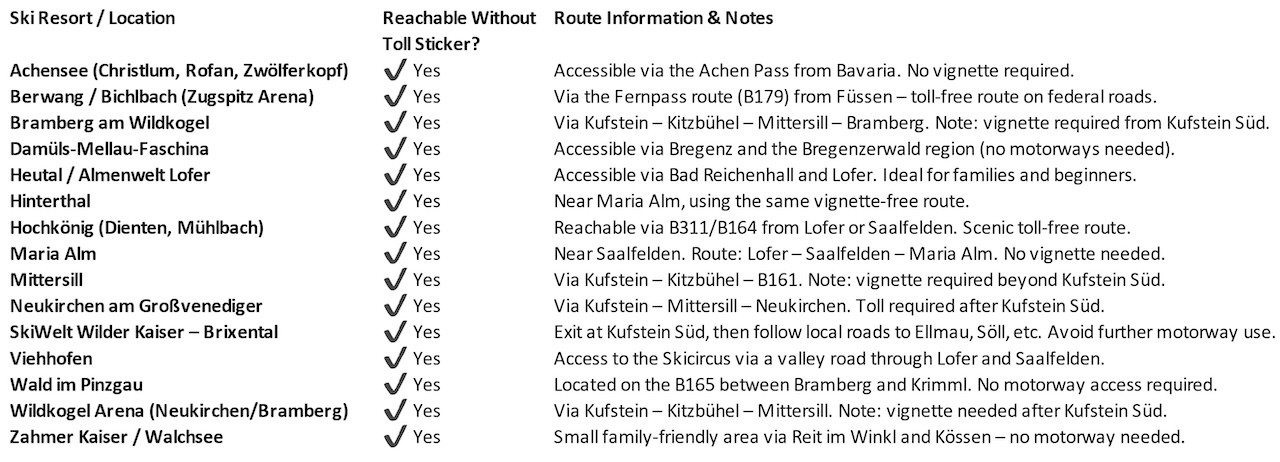
Please note that although some routes go via Kufstein, a vignette is compulsory from Kufstein Süd onwards. To avoid having to purchase a vignette, consider exiting the motorway at Kufstein Nord and continuing via local roads.
Please note: Always check the timeliness of this information yourself. We are not responsible for any fines resulting from driving without an Austrian vignette.
Also read our item: "Which travel documents do I need to go to Austria?"
Do you travel by electric car? If so, be sure to read “Driving an Electric Car to Austria: Holiday Homes with EV Charging”
Toll routes
In addition to the vignette, there are some additional toll sections.
A13 Brenner motorway
A10 Tauern motorway
S16 Arlberg motorway
A11 Karawanken motorway - driving direction south
A9 Pyhrn motorway
2. Winter tyres are mandatory in Austria in winter conditions
From 1 November to 15 April, you must use winter tyres when driving in winter conditions, such as snow, ice or slippery surfaces. This also applies to foreign vehicles. If you do not have winter tyres when driving in winter weather, you are not permitted to drive and are liable in the event of an accident.
What are winter conditions?
It doesn't matter if it's sunny at the time of departure – if you encounter winter conditions on the road, your tyres must meet the required standard. Winter conditions are situations where you may encounter:
- Snowfall
- Snow, mud/mush
- Black ice
- Slippery roads due to freezing or icing over.
What are the requirements for winter tyres?
- They must have at least 4 mm of tread.
- The M+S symbol is no longer sufficient for newly manufactured tyres.
- Tyres must display the snowflake symbol (3PMSF).
What does the snowflake symbol represent?
The 3PMSF (Three Peak Mountain Snow Flake) symbol shows a snowflake within a mountain with three peaks. Only tyres with this symbol are officially approved for use in winter conditions in Austria.
Fine for driving without winter tyres
Would you drive without winter tyres in winter? If so, you risk:
- A fine of up to €5,000.
- Direct liability in case of damage or accidents.
- A ban on driving until the tyres are changed.
Even if you are not involved in an accident, you can be fined for driving without suitable tyres in slippery conditions. Fines can range from around €60 to several hundred euros.
3. Snow chains are mandatory in the event of a sign or slippery conditions
Snow chains may be compulsory in some regions (especially mountain areas). This is indicated by a blue, round road sign with a car tyre and chain. If this sign is there, you must fit snow chains, regardless of whether you already have winter tyres.
Tips for using snow chains:
- Make sure you have snow chains with you, especially if you are travelling to villages or ski resorts at a higher altitude.
- Practise putting them on at home!
- Chains should only be put on the driven wheels.
- Do not drive faster than 50 km/h with them.
- Only use them on snow-covered roads to avoid damaging the asphalt.
4. Required equipment in your car
When driving in Austria, you are required to:
- Hazard triangle
- Safety vests for each occupant.
- First aid box
- Spare lamp kit
Additionally recommended:
- IIce scraper
- Antifreeze
- Sunglasses (against glare on snow)
5. Useful: route & breaks
Depending on your starting point, a car journey to Austria can take quite some time. So plan rest stops. Along the motorway in the countries surrounding Austria, there are many places with toilets, restaurants and playgrounds. Also consider an overnight stay halfway to arrive relaxed.
6. What if you break down on the way to Austria?
The key to a well-prepared holiday is to plan your route, arrange your vignette and pack your ski or hiking gear. But what if your car breaks down on the way? There's nothing more annoying than getting stranded on the Autobahn or in a snowy mountain village. So, what should you do if your car breaks down on the way to Austria?
Stay calm and ensure safety
- Pull your car over as safely as possible, preferably in a car park or on the hard shoulder.
- Put on a high-visibility vest (this is compulsory for all occupants!).
- Place your warning triangle at least 100 metres away on motorways.
Call your breakdown service
Before leaving, check whether you have a breakdown insurance or mobility guarantee through your car insurance or your car brand (e.g. for a leased or new car). Many insurers also offer replacement transport or hotel accommodation in case of breakdown abroad.
Call 112 in case of emergency
Is there any danger, accident or unsafe situation? Then call 112 - the general European emergency number.
In case of breakdown in Austria itself:
Call the ÖAMTC on 120.
Or the ARBÖ on 123.
These clubs often collaborate with foreign emergency services and usually speak English too.
7. Taking your dog to Austria: rules for transport in the car
An increasing number of holidaymakers are bringing their pets, usually dogs, with them to Austria. Many of our holiday homes are therefore dog-friendly. However, be aware that specific traffic rules apply to transporting pets.
Transporting pets: these are the rules
Under Austrian law, a pet counts as a ‘load’. This means that the animal must be safe and secured so that it does not pose a danger in an emergency stop.
Permitted and recommended ways:
- A dog car harness (a special safety belt for the dog, not a collar!)
- Transport box in the boot or on the rear seat.
- Dog rack or net between the boot and the passenger compartment.
So an improperly secured dog in the car is not only dangerous, but can also lead to:
- Fines for dangerous transport in Austria.
- Problems with insurance in case of accidents.
- Restless or stressed animals during the journey.
Tips for travelling comfortably with your dog
- Make sure you let your dog out thoroughly before you leave.
- Make sure there is plenty of water and good air circulation.
- Plan regular breaks so your dog can take a walk.
- Take a cooling mat, a blanket or a favourite toy with you.
- Check that your dog can safely get in and out of the car at rest stops (especially on motorways!).
- Many petrol stations have separate areas for walking dogs, which is convenient and hygienic.
Read all about renting a holiday home with your dog in Austria.
8. Book your holiday home in advance.
Once you arrive, you will naturally want to enjoy comfort and tranquillity. At Ferienhaus-Tirol.eu, you will find hundreds of accommodations: chalets, flats and group houses. Ideal for families, families or friends - even if you bring your dog. Our houses are often close to ski areas, hiking trails or near a lake, and are carefully selected.
Please note that you cannot derive any rights from the above blog. Please check the current legislation and rules carefully.
Would you like more information to help you prepare for your holiday?
👉 Then read our blog ‘Ski Holiday Packing List: the ultimate checklist to avoid packing stress’
Holiday homes Austria: a selection
On holiday to Austria
My name is René Schwarte, founder and co-owner of Ferienhaus-Tirol.eu. With many years of experience in holiday home rentals and deep familiarity with international guest expectations, I understand what makes a vacation truly enjoyable.
Ferienhaus-Tirol.eu offers a wide selection of carefully curated holiday homes, chalets and group accommodations throughout Austria. Whether you're travelling as a couple or with a group of up to 50 people – we help you find the right place with ease.
Our website is available in English, German and Dutch. We speak your language and are happy to assist you with any questions or special requests.
Need help?
Feel free to get in touch – we're here to make your Austrian holiday unforgettable.
Phone: +31854016545 Mail: info@Ferienhaus-Tirol.eu

René Schwarte
Co-OWNER
